Mario Kart 64: 25th anniversary

Mario Kart 64 brought the fun of go-kart simulator Super Mario Kart into the 3D age. A few chunky polygons notwithstanding, Mario Kart 64 still holds up, even alongside sequels like Mario Kart 8 Deluxe.

MK 64 doesn't alter the fundamental formula laid down by Super Mario Kart. You still choose one of four circuits (Mushroom, Flower, Star, or Special) and an engine speed (50, 100, or 150 CC), then race against seven other racers, trying to place at least in the top four. Whereas the SNES allowed only two players, the N64 was built with four controller inputs, and MK 64 happily can use them all (though the music shuts off with more than two). Battle Mode returns as well, in which players attack one another with items, trying to pop all three of their opponents' balloons. This is always a blast when playing with friends. Lastly, there is the Time Trial mode, in which you race alone trying to set the fastest time.
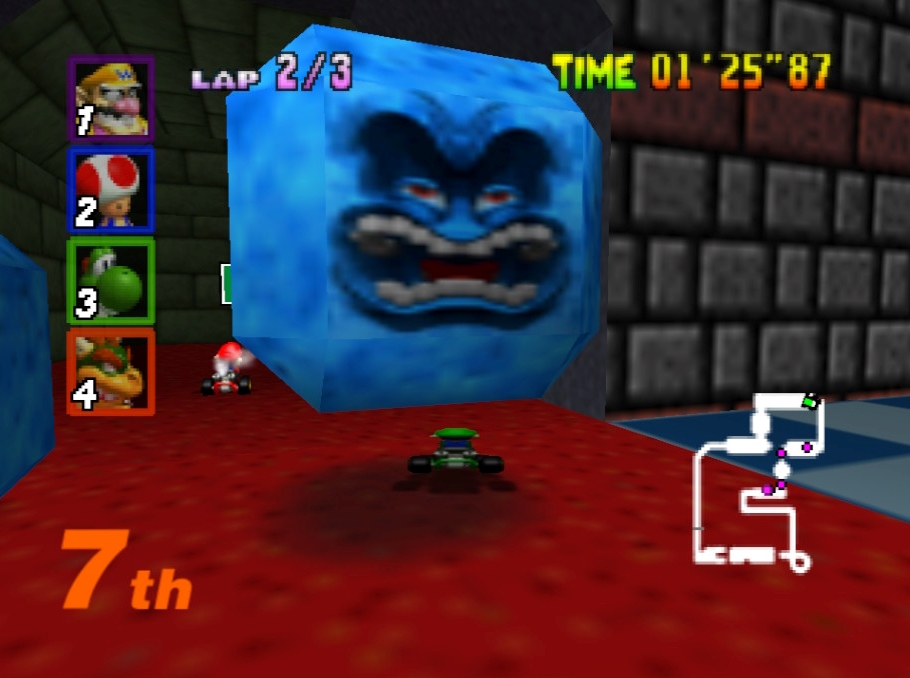
Is this the origin of the "Trollface" meme?
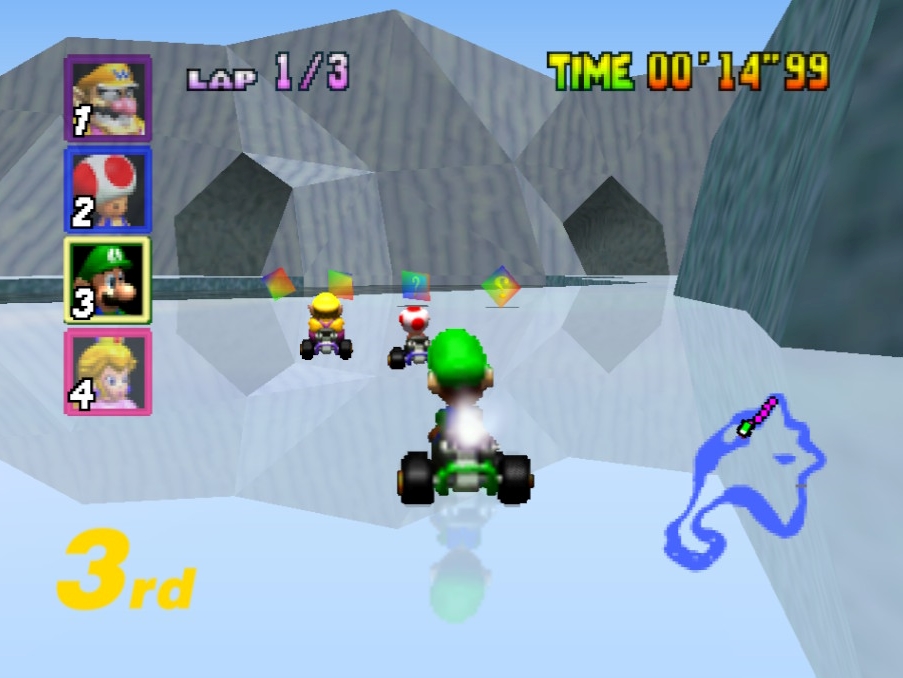
MK 64's biggest and best improvement is the 3D environment itself. Anyone who has played the original Mario Kart knows how flat everything is. Even the walls are 2D, with the only elements on the z-axis being the karts themselves and obstacles like pipes and Thwomps. Racing in three dimensions feels much more real, since you can't see around walls and other barriers. It also allows for slopes, ramps, and ledges to fall off. Despite the antiquated polygons, the environments still look great. In addition, the unique theme music for each track is excellent.

MK 64 adds three new items as well: the spiny shell, fake item box, and Golden Mushroom. The blue spiny shell has become a controversial staple of the franchise: it homes in on the lead player while knocking out anyone who gets in its way. This makes the game more fun for weaker players, as they always have a chance to take out the leader. The fake item box is upside-down and works best when hid among the real item boxes. The Golden Mushroom lets you use unlimited nitro boosts for a few seconds. Besides these, the game includes triple shells and triple banana peels, which rotate around you like a shield, until you have shot them all.

The character roster was adjusted slightly: Koopa Troopa was replaced with a third heavyweight character, the always amusing Wario! DK Jr. was changed to Donkey Kong, who had returned to popularity thanks to the Donkey Kong Country games. The sole area in which the game took a small step back was that each circuit has only four tracks instead of five. But this was a small price to pay when all sixteen tracks were so good. They all contain unique elements, such as the branching pathways of Yoshi Valley and the highway race with cars and trucks that is Toad's Turnpike! And of course who can forget the epic, twisting Rainbow Road in space! Being in 3D, these tracks are more iconic than any from Super Mario Kart.

It's hard to overpraise Mario Kart 64. It is among the best games for the system and one of the all-time great Nintendo games. It's as much fun to play now as ever. Almost everything that has made Mario Kart 8 Deluxe the best-selling Switch game goes back to Mario Kart 64 (and Super Mario Kart). The racing is fast, the controls smooth and intuitive, the multiplayer action a joy, and every course unique and a blast to play.

Grade: A+
Linked Review
"Mario Kart 64 has its faults and later entries would refine the systems introduced here, but there's still plenty of fun here to keep you (and your friends) returning for more."
— Dave Frear, Nintendo Life, 8/10
Comments

Popular posts from this blog

Super Mario Bros. 2: The great American Mario sequel

I began my retro-video-gaming quest two and a half years ago with Super Mario Bros. To celebrate this, my 100th review, I've chosen Super Mario Bros. 2, one of my all-time favorite NES games. Super Mario Bros. 2 is a reskin of the Famicom Disk System game, Dream Factory: Heart-Pounding Panic . Howard Philips, the PR face of Nintendo of America in the early days, rejected the Japanese Super Mario Bros. 2  ("The Lost Levels") for American release because it was too difficult. Mario's creator, Shigeru Miyamoto, helped develop Heart-Pounding Panic. Its creative use of both vertical and horizontal side-scrolling made it the ideal candidate for a Mario sequel. This was a stroke of genius, as it is far superior to the Lost Levels. Its deviations from the Mario formula should not be held against it, because there was no Mario formula back then! Among the many differences from the original Super Mario Bros. is the fact that, at the beginning of each stage, you choose whether ...

Super Mario Land: A short, oddball entry

Super Mario Land was a Game Boy launch title, but not the pack-in game. That honor went to Tetris. Tetris is an incredible game with perennial appeal, and it propelled the Game Boy's explosive success. Super Mario Land is not as impressive but still fun. Super Mario Land is a bit odd. It doesn't feel like other Mario games. Only four of the classic enemies appear: Bullet Bills, Piranha Plants, Goombas, and Koopa Troopas. Even the koopas behave differently: their shells can't be kicked and instead explode like bombs. Most of the enemies are assorted creatures, like spiders, robots, ghosts, and Moai heads. The Fighter Flies from the original Mario Bros. arcade game also appear. The Super Mushroom, coins, and Super Star appear, as well as question blocks. The Fire Flower, however, has been replaced by a similar flower power-up. It lets Mario throw a bouncing ball. It ricochets off walls like an old screen saver, and only one can be on screen at a time. Weird! Extra-life mushr...

The Legend of the Mystical Ninja: A whimsical adventure in Japan

Growing up, I played The Legend of the Mystical Ninja at my best friend's house (though I was bad at it), and I had been looking forward to trying it again. It's an unusual, fun adventure game. I recently learned that in Japan Legend of the Mystical Ninja was preceded by three Famicom games and followed by three more Super Famicom games, none of which were localized for the West! The Japanese name of the series is Go for It, Goemon! It's based on a 1980 Japanese arcade game called Mr. Goemon. The emulation community put out fan translations of the Famicom games between 2009 and 2017. Surprisingly, no translations of the Super Famicom games existed until 2020, all three created by the same people . The series takes place in early-modern Japan. It has a light-hearted anime aesthetic. The titular character is a spiky-haired kid named Goemon. If a second player joins the simultaneous action (highly recommended), Goemon is assisted by an older, overweight ninja named Ebisumaru. ...